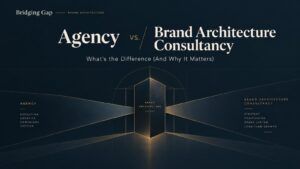
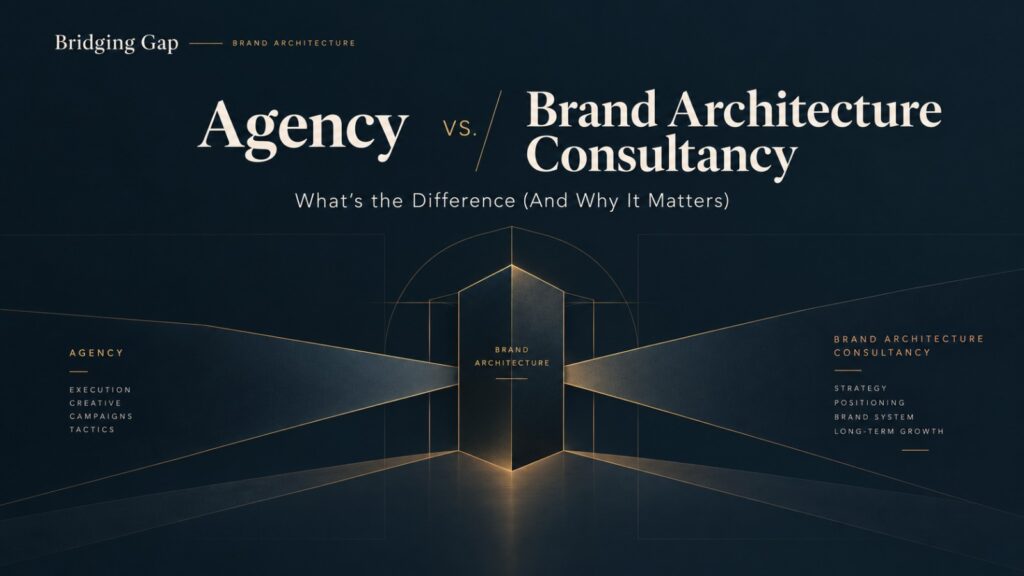
Most businesses shopping for brand help don’t realize they’re actually choosing between two different kinds of partner, not two different flavors of the same service. The brand agency vs brand consultancy question sounds like a matter of preference — bigger team versus smaller, cheaper versus pricier, faster versus slower. It isn’t. It’s a question of what kind of problem gets solved first: how the brand looks, or why the brand isn’t working. Get that order backwards and you can spend real money and still end up exactly where you started, just with a nicer-looking version of the same gap.
What a brand agency is actually built to do
A brand agency is, at its core, a production business. Its strength is execution: design, copywriting, video, campaigns, media buying, sometimes all of it under one roof. Agencies are good at this because they’re structured for it — creative teams, account managers, production pipelines built to take a brief and turn it into finished assets on a schedule. That’s a genuinely valuable capability, and for a business that already knows exactly what it needs to say and just needs someone to say it well, an agency is often the right call.
The brand agency vs brand consultancy distinction starts to matter the moment a business isn’t sure what it needs to say yet. An agency’s business model depends on briefs — someone has to arrive with a reasonably clear idea of the problem before the agency can execute against it. If the actual problem is that nobody in the business agrees on the positioning, or the pricing keeps getting negotiated down, or the sales team is telling a different story than the marketing, an agency will still execute — but it will execute on whatever brief it’s given, accurate or not.
What a brand architecture consultancy is built to do differently
A brand architecture consultancy, by contrast, is built around diagnosis first. Harvard Business Review’s research on brand positioning makes the underlying point clearly: a brand’s real position only means something relative to what it’s being compared against, and figuring that out requires actual strategic work before a single visual direction gets proposed. That’s the core of the brand agency vs brand consultancy divide — a consultancy’s first deliverable isn’t a creative concept, it’s clarity about what the brief should even say.
At Bridging Gap, that diagnosis happens through what we call the Brand Gap Diagnosis — a structured look at where a business’s commercial reality and market perception have separated, before anyone talks about logos, colors, or campaigns. This is the most practical version of that divide: one starts with “what do you want us to make,” the other starts with “what’s actually broken, and is a new brand even the right fix.”
Why the order of operations changes the outcome
McKinsey’s research into B2B branding frames brand as a mechanism that reduces a buyer’s perceived risk across every touchpoint where perception forms, long before a sales conversation starts. If that mechanism is broken — if the brand isn’t actually reducing risk the way it should — no amount of skilled execution fixes it, because execution was never the problem. This is where the brand agency vs brand consultancy question stops being about preference and starts being about whether the engagement is solving the right layer of the problem at all.
An agency asked to “make the brand look more premium” will produce something that looks more premium. Whether that solves the actual issue — say, a pricing conversation that keeps getting negotiated down because nothing in the pitch justifies the number — is a different question entirely, and often one nobody asked before the brief was written. A consultancy’s job is to ask that question first, so the execution that follows, whether done in-house or handed to an agency afterward, is actually aimed at the real gap.
The cost of skipping the diagnosis
Edelman’s ongoing trust research makes a case worth sitting with in the context of brand agency vs brand consultancy decisions: trust functions as a filter that determines whether a company is even considered before a purchasing decision happens, not a layer added after the fact. A rebrand built without diagnosing where that trust is actually breaking down is essentially a guess dressed up as strategy. Sometimes the guess lands. Often it doesn’t, and the business ends up paying twice — once for the agency work, and again for the diagnosis that should have come first.
We’ve watched this pattern repeat across two decades of client work: a business commissions a full identity overhaul from a capable agency, the execution is genuinely strong, and six months later the same brand gap vs sales pitch problem — lost deals, negotiated pricing, buyers who don’t quite trust the story — is still sitting there, untouched, because nobody actually located it before reaching for a solution. That’s not a failure of execution. It’s a failure of sequence, and it’s the clearest practical argument for why the brand agency vs brand consultancy distinction matters more than most businesses assume going in.
When an agency is genuinely the right call
None of this makes agencies the wrong choice categorically. If a business has already done the strategic work — clear positioning, a message that’s been tested and holds up, a pricing story that lands — an agency is exactly the right partner to execute that clarity into strong creative work at scale. Forbes’ coverage of brand differentiation makes a related point: most differentiation failures aren’t about lacking a distinctive idea, they’re about failing to commit to expressing it consistently. If the idea is already sound, execution is the remaining job, and that’s squarely agency territory.
The brand agency vs brand consultancy decision, in that scenario, isn’t really a decision at all — the strategic groundwork is done, and what’s left is production. The mistake is skipping straight to that stage when the groundwork hasn’t actually been laid, which is a more common situation than most businesses realize once someone actually looks for it.
How to tell which one you actually need
A useful test for the brand agency vs brand consultancy question: can you currently articulate, in one sentence, what makes your business the right choice for your best-fit customer — a sentence your sales team, your website, and your leadership would all say the same way? If yes, you likely need execution, and an agency is a reasonable next step. If the answer is vague, inconsistent across the people who’d have to answer it, or different depending on who you ask, that’s a sign the actual gap is upstream of execution, and a diagnosis should come before any creative brief gets written.
Bain & Company’s research into customer experience leadership found that the companies leading their categories weren’t the ones investing the most broadly — they were the ones who’d identified precisely where their experience was underperforming before spending anywhere at all. That’s the same logic behind the brand agency vs brand consultancy choice: precision about the actual problem beats broad investment in execution, almost every time.
Why we built Bridging Gap as a consultancy, not an agency
We deliberately built Bridging Gap around the consultancy model rather than the agency model, because the pattern we kept seeing — across contractor companies, hospitality brands, manufacturers, and professional services firms — was businesses that had already tried the agency route once or twice, gotten strong creative work, and still hadn’t closed the actual gap. Our brand architecture programs start with diagnosis specifically because the brand agency vs brand consultancy sequence matters as much as the quality of either one’s execution.
This isn’t a knock on the agency model as a category. Some of the strongest creative work we’ve seen has come out of agencies working from a brief that was already clear. The businesses that struggle are the ones who hired an agency to figure out what to say, when figuring that out was never really an agency’s job to begin with — it’s a strategic function that has to happen before the brief is written, not during production. Confusing the two is how a business ends up with three rebrands in five years and the same unresolved gap each time, just wearing a different visual identity.
What this looks like when it’s done in the right order
When the sequence is right — diagnosis first, execution second — the difference shows up almost immediately in how the work gets briefed. Instead of “we need a new logo and a refreshed website,” the brief becomes something much more specific: “we need our identity to signal enterprise-grade reliability to a buyer who currently sees us as a smaller regional player,” or “we need our messaging to lead with the credential that actually closes deals, instead of the generic value proposition we’ve been running for three years.” That level of specificity doesn’t come from a creative workshop. It comes from a diagnosis that named the actual gap before anyone started designing around it.
Interbrand’s research into the world’s most valuable brands reinforces why sequencing matters at scale: the brands that hold their position over time aren’t the ones with the most polished individual assets, they’re the ones whose entire system — strategy, message, and execution — stays coherent as the business grows. That coherence starts with diagnosis, not with a creative brief.
Choosing the right partner for where you actually are
The brand agency vs brand consultancy decision isn’t about which one is “better” in the abstract. It’s about matching the type of help to the type of problem. If your positioning is clear and tested, an agency will execute it well. If you’re not sure why deals keep stalling, why pricing keeps getting negotiated, or why your brand doesn’t seem to land the way your product actually performs, that’s a diagnosis question first, and a consultancy is built to answer it before a single design file gets opened.
Our About Us page walks through how we structure that diagnosis, and our past work shows what’s followed once the actual gap was named. If you’re not sure which side of the brand agency vs brand consultancy question your business is on, that’s exactly what a diagnosis is for.
Book a free Brand Gap Diagnosis and find out whether your business needs execution, strategy, or both — before you commit budget to either one.